Sunday, August 8, 2010

Odds and Ends and Trellis Stitch

Another project that I have up and running this year is a reproduction of the Jane Turner Sampler of 1668, which is available through The Essamplaire  You can see the entire sampler here.  I find that with reproduction samplers, I tend to be drawn to the earlier ones (mostly 17th century), and I do like those with at least one central pictorial motif, like the lady in the garden of this sampler. 

Unlike some stitchers, I am not adamant about exact historical recreation, and I plan to only stitch this piece through the garden pictorial band and the two narrow "gardeny" bands under it.  I personally do not care for the unsymmetrical wide flower band near the bottom or the off-center alphabet, so I plan to just stop!

I have had several issues with this piece. . . mostly having to do with color substitution.  I found that a couple of the specified colors just disappeared into the fabric.  This is especially frustrating when doing reversible double-running, since under the best of circumstances you often can't really see what you're doing until you do the second pass.   Here's a photo of the top third of so of the sampler that I've either completed or have well underway.


An interesting feature of this sampler is that many of the double-running outlines (which I personally really enjoy stitching), are filled in with satin stitch.  It makes for a nice effect when finished, but is rather tricky to stitch.  Looking at a fairly good photo of the historic piece, it appears that Jane used filament silk for her satin stitch, which looks quite different than satin using DMC.  In order to get a result I liked, in my piece I've made most of my satin stitch horizontal across the little motifs, rather than vertically along the motifs as Jane did. 

My most recent accomplishment is the trellis stitch filling in the main stem of the band pictured below.  I've never used trellis stitch in quite this way. . . and procrastinated quite a bit before attempting it because I usually have issues with trellis stitch.  But much to my surprise, it came out pretty well.  (General rejoicing!)


Here's a close up of part of the band showing part of the double running outline before the trellis filling and with the filling stitches.


Interestingly, in her sampler, Jane only did trellis stitch in the longer and wider sections of the central stem and just filled the narrower W-shaped sections (like that circled in blue in the photo below) with satin stitch. To my mind, this ended up looking rather messy, so I took a DEEP breath and decided to try to do a trellis filling throughout.  While not perfect, I think it looks pretty good.  (More rejoicing!)


Friday, August 6, 2010

Mermaids and Manatees

I haven't been stitching much for a couple of weeks. . . at least in part because we've spent a relaxing week scuba diving and just kicking back in Key Largo.  Heavy use of sun screen and steamy hot temperatures are definitely NOT conducive to stitching!

But even in the quiet keys, my stitching projects kept popping up in unusual ways.  Several times at sunset we glimpsed a pair of manatees -- mom and baby -- in the canal right outside the apartment we had rented for the week.  It was fun to see them (well....sort of see them, since 99% of the time they were under water).  But it also brought to mind my little mermaid. . . . since one theory of the origin of mermaid sightings is that mariners caught sight of manatees and THOUGHT they had seem mermaids.  Is that really possible?


Mermaid as interpreted in my souvenir
ornament from Key Largo

Manatees

. . . . well.....I guess maybe it could be possible, but if so, BOY those sailors had been away from home WAY too long, or had been enjoying their rum ration WAY too much.  Needless to say, my intent is that my 17th century style stumpwork mermaid more resembles the ornament than the manatees!

Wednesday, July 28, 2010

Return of an Old Friend

Few things make me happier than learning there's a new book out by one of my favorite authors.

One such author is Barbara Hambly who writes a fascinating mystery series featuring Benjamin January, a free man of color who is also a physician and musician, and ALSO solves crimes in 1830s New Orleans. The series is especially interesting in its unusual setting -- at a time when the unique French culture in Louisiana is colliding with that of the United States (of which it has been a part since the Louisiana purchase). As a Publisher's Weekly review of the first book in the series puts it, "Riverboat dandies and roughshod frontiermen rub elbows with dueling gentlemen of the landed aristocracy as their splendidly gowned wives and colored mistresses celebrate Mardi Gras, oblivious to the squalor, fever and plague around them." 

Recently Ms. Hambly has taken a break from the series to do several other books (both very good!) set in 19th century America. But this summer, Ben January is back in a new mystery, Dead and Buried (A Benjamin January Mystery).  Things start with a bang when a coffin is dropped right in the middle of a funeral, and the wrong corpse falls out! I won't say much more, so I don't give anything away. But if you're looking for a great summer read I highly recommend Dead and Buried or any other books of the series.
 

Thursday, July 22, 2010

Goldwork Class Sampler - Silk Stitching Completed

Hurray!  I've finished the silk sections of the first Thistle Threads Gold Masterclass sampler!  I must say I wasn't too enthusiastic about all those queen stitches when I started, but they really began to grow on me.  I like the way they create a just slightly raised brocade-like effect, along with the slightly lacy look of the pulled thread. 


I mostly kept the colors as indicted in the instructions - so the photo looks A LOT like the many others people have posted.  But I did make several small changes that I'm very pleased with.  In the large honeysuckle in the upper left hand corner, the diagonal pink sections of the flower were originally yellow/gold, and in the smaller honeysuckle beneath it, I changed the pink sections from the very dark pink to a lighter pink.  But the biggest change is the blue pansies.  Blue is my favorite color, and I really like the pansies done in the blues. 

I also really like the little strawberries.  On vacation earlier this year, I saw a 17th century piece done in a very similar strawberry pattern.  I need to find my notes and move ahead playing with the motif a bit more.

Now on to the starting the goldwork!


Wednesday, July 14, 2010

Previous Goldwork

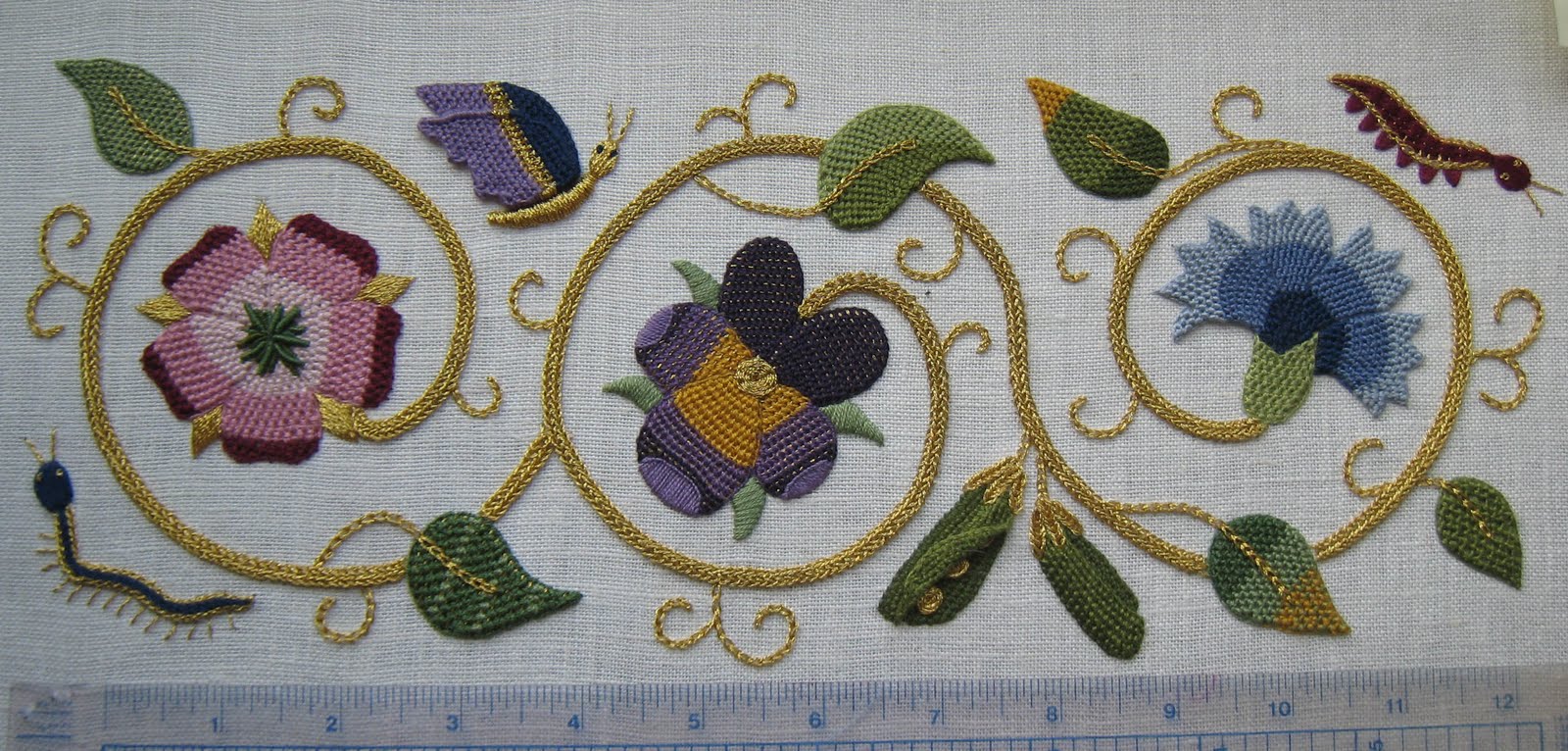
I am ALMOST finished with the silk stitching on the Goldwork Master Class Sampler. . . which means I'm almost ready to begin the goldwork.  On the class blog people have mentioned earlier experiences with these stitches.  My previous work with goldwork STITCHES (as opposed to couched gold) was mostly on Jane Zimmerman's Elizabethan embroidery piece, which I took at a class back in 2005.  Jane has a great website where a lot of her patterns and books are available at http://www.janezimmerman.com/ .

Here's a picture of the ALMOST finished piece.  All that's left to do is to attach the spangles. . . which I PROMISE to actually do this month. . .assuming I can find the paillettes.  As you can see from the ruler along the bottom of the photo, this piece is a little larger in scale than some.  The silk work is a mixture of 2 or 3 strands of Needlepoint, Inc. silk, and the gold is a Kreinik Braid.


There are four goldwork stitches on this sampler. . . chain stitch (used as the stems of most leaves), heavy chain (stems of the pea pods), spider web (the peas in the open pod), and plaited braid (the main curved "branch").


Heavy chain caps of pea pods
Spider web peas in the open pod
Plaited braid main stem at right and left 


Chain stitch stem 

Thursday, July 8, 2010

Plugging Away

Stitching continues on the mermaid grotto and goldwork sampler. . . as well as a few other projects. 

The mermaid herself is beginning to take shape, with the needlelace body and tail sections done and stitched to the background material and padding.


On the sampler, I've finished the pansies and white flower and started on the more geometric motifs that appear at the bottom of the piece.  I made a change in the color of the pansies, which I did in blues, since blue is my favorite color. . . and the yellow and tan colors of the original aren't.  I'm pleased with the change and think it works well with the piece overall.


 Today's problem -- the next step on the mermaid is a scary one. . . doing the top layer of her body and face.  As a counted thread stitcher at heart, I always DREAD situations requiring freer surface embroidery.  I want my little mermaid to be pretty and fetching. . . and not looking like a drawing done by a toddler.  So. . . fingers crossed.. . . it's on to mermaid finishing.

Friday, July 2, 2010

Gold Master Class - Scrambling to Catch Up

Between creating threads for mermaid grotto rocks, I'm also trying to keep up with the Thistle Threads On-Line University Goldwork Master class.  The first piece is a small sampler featuring a bunch of small samples of complex looking goldwork stitches.  You can see a picture of the finished sampler here.

But before work can really begin on the goldwork, the silk stitching needs to be in place.  Doing that was the "assignment" for May, but since June's addition is just a simple gold stitch or two, we do have time before falling hopelessly behind.

After several weeks of fairly intense work on this (and a fair amount of reverse stitching as well), I have almost half of the silk work done. 


As you can see, the silk is almost entirely done in Queen Stitch. . . which is really pretty, but not especially fast to work.  The intricacies of this stitch have also inspired quite a bit of back and forth over the net.  You can find a very comprehensive summary on Elmsley Rose's blog .  One of the big issues has concerned how much pull to put on the stitch.  I personally think I work this stitch with a moderate pull. . . but looking Tricia's stitched piece, mine seems a little more pulled.  Those of us taking the course have access of photos of the original 17th century piece, and in it, the queen stitches are MUCH more tightly pulled.  Interesting range of variations for this single stitch....